Reader setup
Before you diagnose
- The read-only account and option file from Create a read-only database account for safe VICIdial queries, needed before either query below will run.
- At least two comparable routes or carriers already carrying the same campaign's traffic, so outcomes can be compared across routes rather than only before-and-after one point in time.
- The exact date any carrier, route, or AMD setting last changed, since every comparison below is only honest when you know what else moved on the same day.
- Expected result
- You can compare recorded status counts and identify evidence needed to investigate carrier signaling, audio delivery and AMD classification before changing a setting.
- Before making changes
- Do not change AMD, dial ratio, or carrier routing from this guide; its evidence tells you which of this library's other guides to open next, and it deliberately stops short of making that change itself.
AMD and FAS are two different failures
AMD, or Answering Machine Detection, is Asterisk's automatic check, in the first second or two after a call connects, for whether a human or a machine answered. FAS, or false answer supervision, is a separate and carrier-side problem entirely: a carrier's switch reporting a call as answered before anyone, human or machine, has actually picked up.
These are two different failures, and the forum report that prompted this guide conflates them in its own title — worth separating here so you diagnose the right one instead of assuming AMD broke just because a carrier changed.
A VICIdial forum thread reports over 40 percent of connected calls coming back as dead air or an answering machine, with AMD already on, right after a carrier change — asking, in effect, whether the carrier is the problem or AMD is.
Reference screenshots 3 images
Reference capture
Reference screens from the demo
Captured on an isolated VICIdial demo: Administration screens on September 24, 2026, and the idle Agent screen on August 11, 2026. Each caption states its own capture time, and every sanitized image helps you recognize a related screen; none proves that this article's call, command, or result occurred.Find carrier administration
Open to enlarge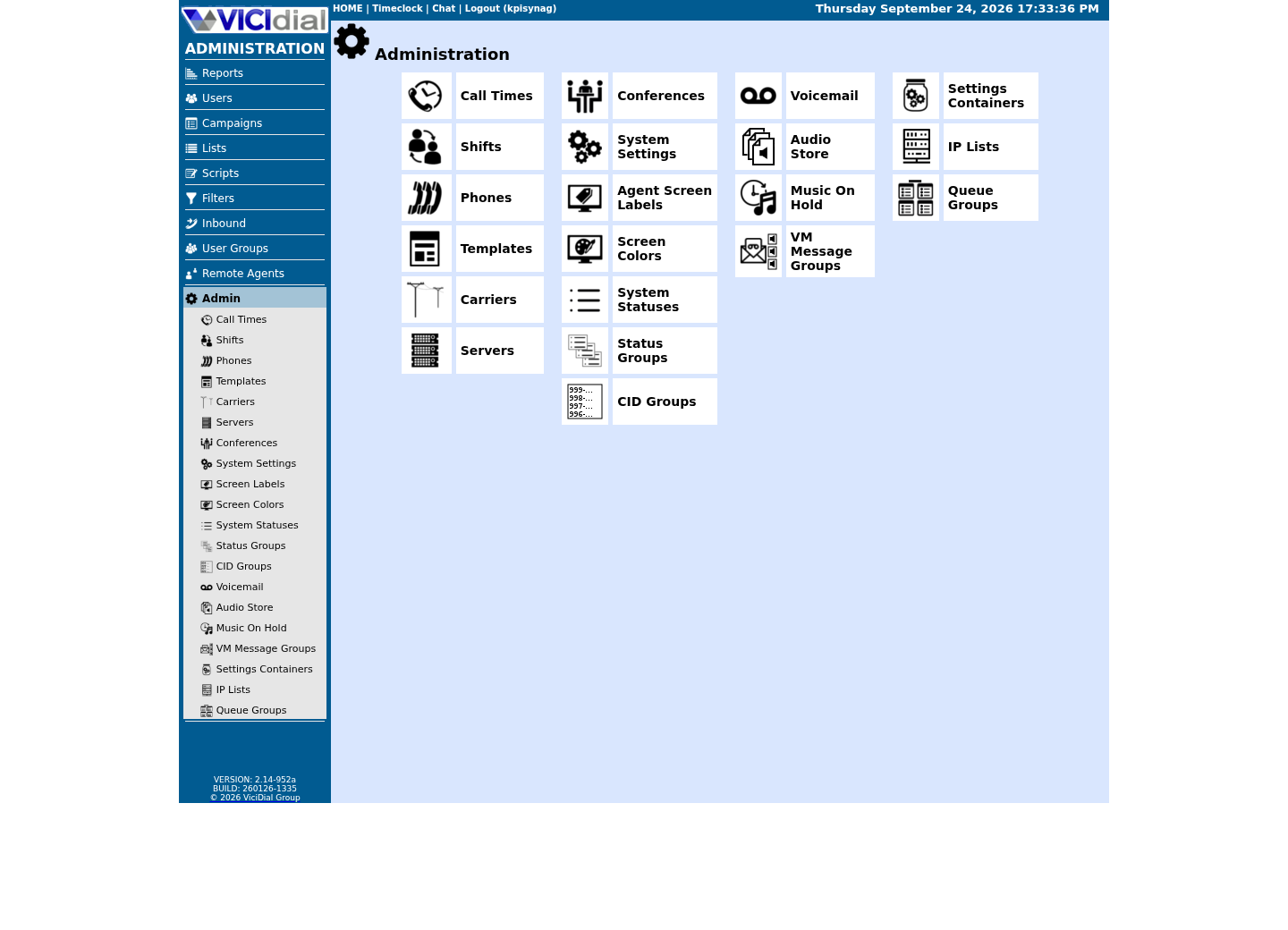
Capture details
This menu is a navigation map only; it does not show that any system-wide setting was changed or verified.Open Carrier Listings
Open to enlarge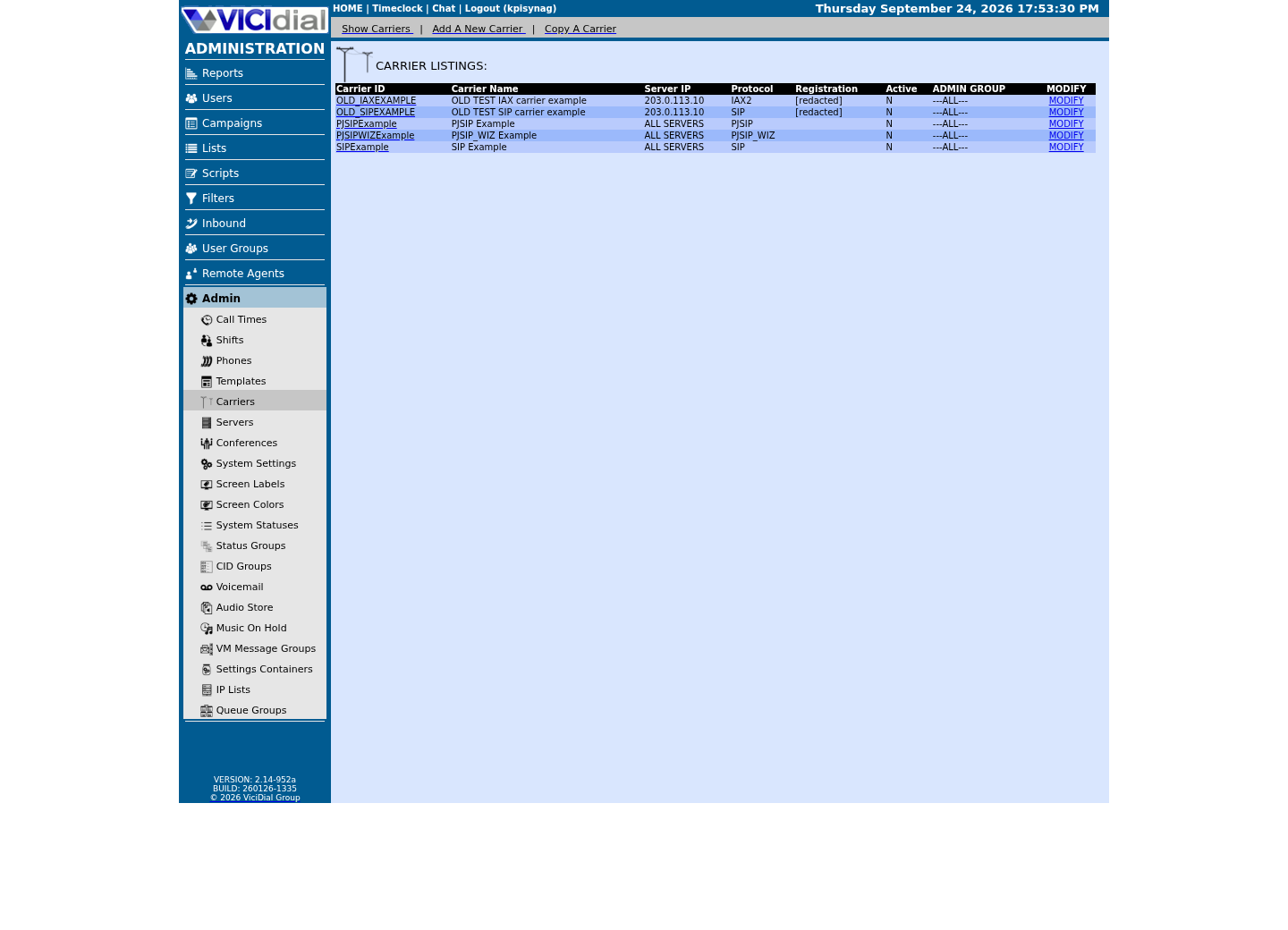
Capture details
Only stock example carrier rows are shown, with addresses replaced and registration values redacted; no real carrier is present. This does not prove registration, routing, audio quality, or a completed call.Check the allowed SIP-stack setting
Open to enlarge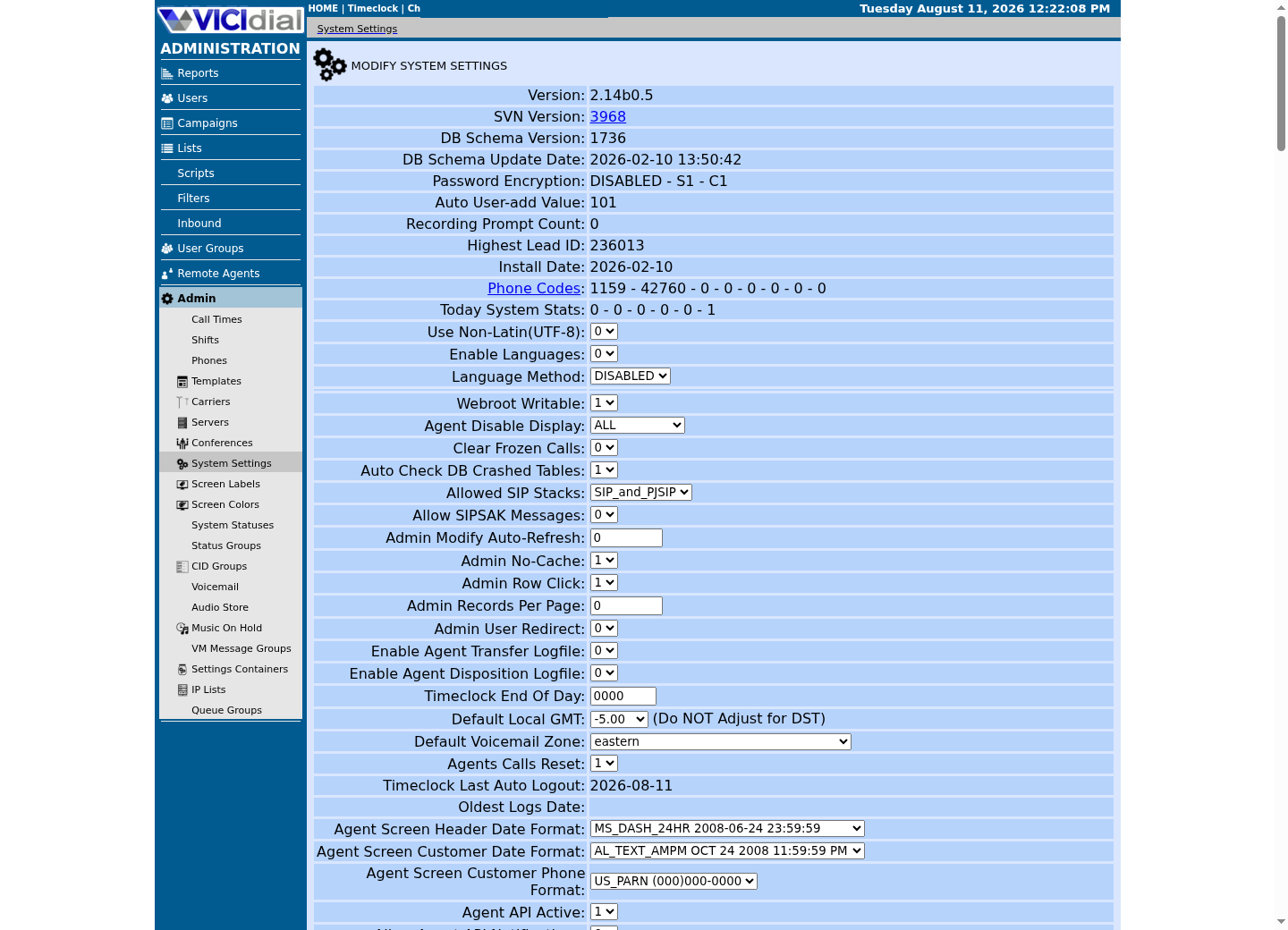
Capture details
This is a read-only view of system-wide settings with no credentials or addresses; it does not prove that a setting was changed or that an API request succeeded.Both failures share the same post-answer window
VICIdial marks a call PU, meaning "Call Picked Up," the instant the carrier sends the Answer signal — its own status reference is explicit that this happens "before the call is sent on to an agent." AMD then listens against that same post-answer window to decide whether a human or a machine picked up.
An early Answer signal can start answer-based timing before a person picks up. Billing depends on the carrier agreement and its records. AMD observes the available audio; a dead-air status alone cannot prove the carrier sent Answer early.
This is why the complaint reads as one thing and can be two: a rising dead-air or machine share costs you both ways, in agent time spent on calls that were never truly live and in per-minute charges for connections that only exist on the carrier's own meter. Telling which side actually caused a given call's outcome is the entire point of the split below.
Choose the next hypothesis from evidence
A carrier change is a time marker, not a likelihood ranking. Compare comparable leads and the same window across available routes. Work through signaling, media, list mix and AMD evidence separately.
- Signaling hypothesis: an answer timestamp precedes known test-endpoint pickup; collect both sides before calling it FAS.
- Media hypothesis: received audio is absent or one-way; compare SDP/RTP direction and timing with the network owner.
- List hypothesis: routes carried leads of different age or prior-attempt history; match cohorts before comparing shares.
- AMD hypothesis: authorized labeled greetings disagree with classifications under the same route/settings; use the separate AMD test procedure.
Query the official status split this triage depends on
VICIdial maps ADAIR to AMD’s NOAUDIODATA cause. That is not the same observation as receiving audio frames containing initial silence. AMD can return MACHINE when initial silence exceeds initialSilence, so AA/AM/AL do not prove that a recorded machine greeting was heard. They record classification/handling stages; identify AMDCAUSE and the media direction before assigning cause.
Count these statuses over the same campaign/window, then compare validated carrier groups. A split is an investigation clue; it does not establish false answer supervision, a human greeting or the absence of received RTP.
- Before you use it
- Run this over the full suspect window first, so you know the overall size of the dead-air share versus the machine-classified share before breaking either one down further.
SELECT status, COUNT(*) AS calls FROM vicidial_log WHERE campaign_id = '<CAMPAIGN_ID>' AND call_date BETWEEN '<START_DATETIME>' AND '<END_DATETIME>' AND status IN ('ADAIR','AA','AM','AL') GROUP BY status;Captured demo response · 2026-09-23 21:35 UTC. Any filtering, hidden values or test-only data are identified in the capture label. Select Replay transcript to read the recorded output.
- Success looks like
- The two families are roughly proportioned the way they were before your suspected change, or you already have a sourced explanation for why they should now differ.
- Stop if
- If ADAIR rises, investigate audio and answer signaling as well as AMD configuration. Compare the same interval and call population; these counts alone do not identify the cause.
Break the same split down by carrier
The example below derives a label from the channel name. Naming conventions vary and hyphens can occur in endpoint names, so confirm the derived label against your routing configuration before treating it as a carrier ID. Also check whether the join produces more than one carrier-log row per call; duplicates inflate counts.
- Before you use it
- Validate the channel-name parsing and the number of carrier-log rows per call on your build before using these counts. Hyphenated endpoint names and multiple rows per call can make the grouping or totals wrong.
SELECT SUBSTRING_INDEX(SUBSTRING_INDEX(vcl.channel, '-', 1), '/', -1) AS carrier_id, SUM(vl.status = 'ADAIR') AS dead_air, SUM(vl.status IN ('AA','AM','AL')) AS amd_classified, COUNT(*) AS total_calls FROM vicidial_carrier_log vcl JOIN vicidial_log vl ON vl.uniqueid = vcl.uniqueid WHERE vl.campaign_id = '<CAMPAIGN_ID>' AND vl.call_date BETWEEN '<START_DATETIME>' AND '<END_DATETIME>' GROUP BY carrier_id;Captured demo response · 2026-09-23 21:35 UTC. Any filtering, hidden values or test-only data are identified in the capture label. Select Replay transcript to read the recorded output.
- Success looks like
- After validating grouping and denominator, compare routes carrying similar traffic. A difference is a lead for investigation, not proof of carrier-side fault.
- Stop if
- A similar share across routes does not identify the cause. Compare audio-path, list and AMD evidence for the same time window.
Hold the list constant while you compare routes
Before treating a carrier-level difference as proof, confirm the two routes were actually carrying the same list, or at least comparable ones, during the window you queried. A route that happened to carry an older, more-worked list will show a higher machine and dead-air share for reasons that have nothing to do with the carrier, which is exactly the confusion the second ranked cause above describes.
Compare an existing period where both routes handled comparable leads. A new split would change live routing and needs a separate, authorized test plan; this guide does not direct that change.
Confirm what your installed AMD actually supports
One read-only check confirms what your installed Asterisk actually supports for AMD, rather than assuming its arguments from a version used somewhere else.
- Before you use it
- Run this on the Asterisk host itself; AMD is a dialplan application, not a campaign setting, so this shows what your installed version actually accepts.
asterisk -rx 'core show application AMD'Captured demo response · 2026-09-23 21:35 UTC. Any filtering, hidden values or test-only data are identified in the capture label. Select Replay transcript to read the recorded output.
- Success looks like
- The help text returns for your installed version, confirming which arguments and return values are actually available before comparing them to anything a carrier or a forum post claims.
- Stop if
- AMD is absent, or the help text is for a version you were not expecting — stop and confirm your actual Asterisk version before trusting any AMD-related comparison.
Route the evidence, do not reach for a setting
Share a validated route comparison and relevant timestamps with the carrier and your telephony administrator. Investigate signaling and media on both sides; ADAIR counts alone do not prove a carrier fault.
Route AMD-classified evidence instead to Tune AMD without burning good leads, this library's dedicated AMD-tuning guide, which covers building a labelled corpus and testing a candidate setting safely; this guide does not repeat that method here. If dial pacing itself turns out to be a contributing factor, Optimize VICIdial dial ratios and AMD for better connection rates covers measuring and adjusting that separately.
Repeat the same comparison after the dispute or the tuning change
Repeat the same grouped query, by status and by carrier, over a comparable later window once the carrier dispute or the AMD-tuning guide's own change has actually taken effect.
- The ADAIR share for the previously affected carrier has moved back toward its earlier baseline.
- Record the AA/AM/AL share and other changes in the same period; a change in the share alone does not establish which change caused it.
- Record the dates of relevant changes and avoid assigning causation from timing alone.
When to stop and hand this to someone else
Escalate rather than re-running the same query hoping for a different answer when the carrier disputes your evidence outright, when an AMD change already made through a proper canary test itself raises the false-machine rate, or when the same pattern reproduces across multiple carriers at once — that last one in particular points back at your own configuration, not at any one carrier.
Checks and sources
What was checked
- VICIDIAL_statuses.txt defines PU as the status set "as soon as the carrier has sent the Answer signal and before the call is sent on to an agent," which this guide's mechanism section relies on directly.
- The same reference defines ADAIR as "Dead Air Auto, for AMD NOAUDIODATA calls," distinct from the AA/AM/AL family this guide compares it against.
Primary references
Sources
- Is my carrier scamming me (FAS)? Over 40% of connected calls are dead air or answering machines with AMD onVICIdial forum · accessed September 23, 2026
- VICIdial StatusesVICIdial · accessed September 23, 2026