Reader setup
Before you choose
List your constraints, required evidence and stop rules before you score options.
- Your own peak concurrent agent count, distinct monthly agents and connected minutes, since every vendor named here prices against one of those three numbers.
- Read-only database access to your VICIdial install, for example through /etc/vicidial-readonly.cnf — see vicidial-read-only-database-account if you do not have one yet — if you want to run the queries in this hub yourself.
- A named owner for the telephony and carrier question, since only VICIdial and, partially, Amazon Connect avoid a seat license, and someone still has to own the phone line.
- What you will prove
- You will know which of the five vendor comparisons and two framework articles on this site actually matches your seat count, shift pattern and appetite for owning telephony, instead of reading all seven before deciding.
- Safety boundary
- This is a routing page, not a benchmark, a feature-parity claim or a vendor endorsement; it names no winner among the platforms below and states no VICIdial total-cost figure. Reverify every price directly with the vendor before budgeting.
Reader path
How to use this article
- Use it when: You are comparing options and need decision evidence before approval.
- Expected result: Turn options into explicit acceptance criteria and documented stop conditions.
- Start here: Score what is mandatory, keep unknowns visible, then decide only when risks are understood.
Start with three numbers, not five feature lists
Fast answer: five cloud contact-center-as-a-service (CCaaS) platforms get compared against VICIdial on this site — Five9, Talkdesk, RingCentral RingCX, Genesys Cloud CX and Amazon Connect — and each dedicated comparison has already been written in full. What decides which of those five pages is worth your time is not a feature list; it is how each vendor charges you and what minimum you have to clear before the price even applies. Answer that with your own numbers first, then go read the one page that matches your situation.
New to agent, campaign, carrier, DID, dial level or disposition? “VICIdial terminology for complete beginners: users, phones, campaigns and leads” defines each of those once, in plain language, before this hub leans on any of them.
This hub does not rank Five9, Talkdesk, RingCX, Genesys Cloud CX or Amazon Connect against each other or against VICIdial. It sorts them by the two or three facts that actually change which comparison is worth pricing out, then routes you to the page that argues that one comparison in depth. Some of these products are also sold bundled with unified-communications-as-a-service (UCaaS) features such as internal messaging and video; this hub compares contact-center pricing and licensing only, not a bundled UCaaS feature set.
- This hub does not rank the five vendors below it, and states no VICIdial total-cost figure; read the dedicated page for the vendor that matches your situation.
- Every price cited below is dated August 5, 2026 and read from the vendor's own pricing page; reverify before budgeting.
- Know your own peak concurrent agents, distinct monthly agents and connected minutes before pricing anything against a quote.
Visual walkthrough
Follow three real demo screens
Captured on an isolated VICIdial demo: Administration screens on September 24, 2026, and the idle Agent screen on August 11, 2026. Each caption states its own capture time, and every sanitized image helps you recognize a related screen; none proves that this article's call, command, or result occurred.Start at Administration home
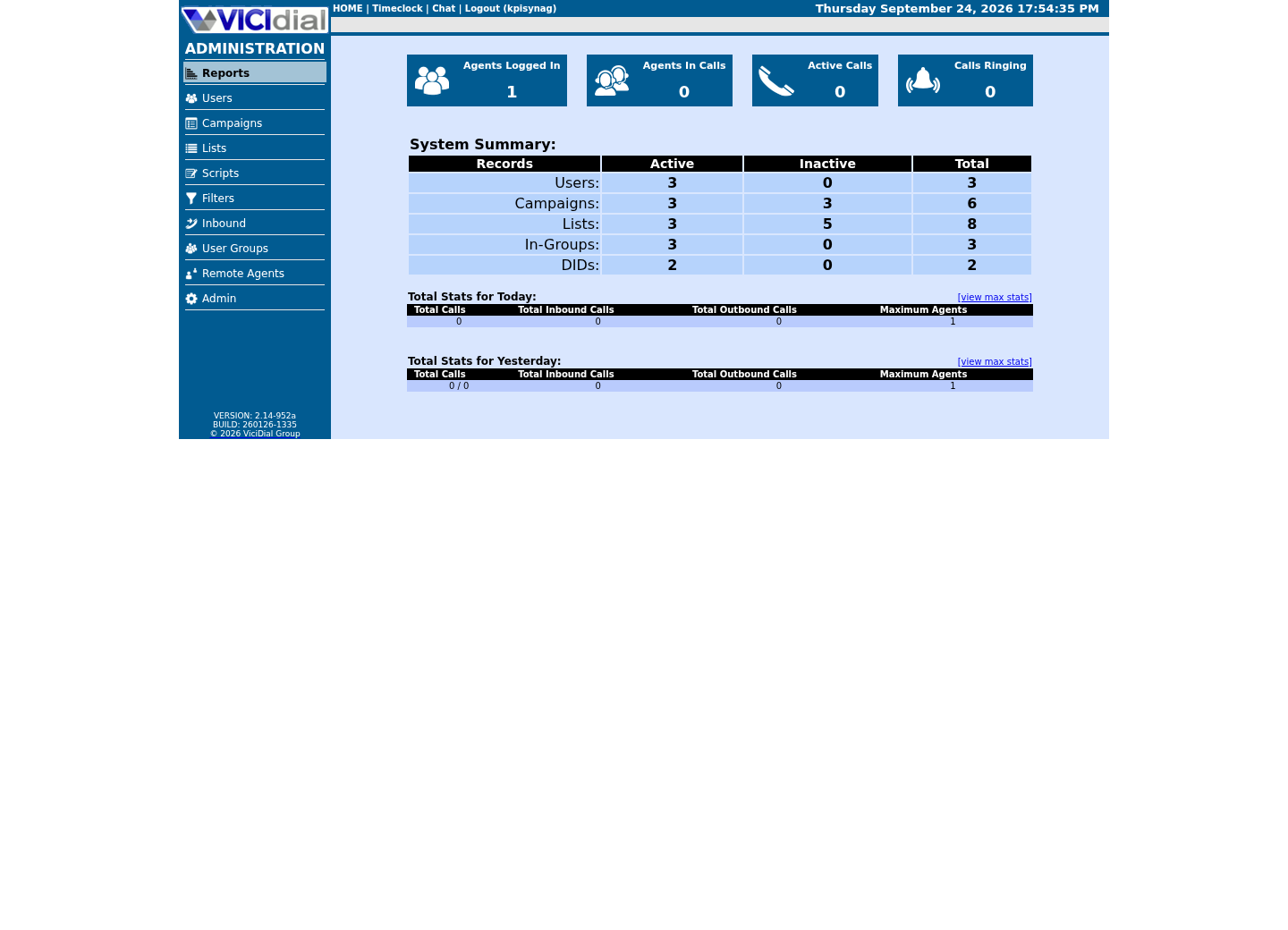
Use the Administration menu as a map
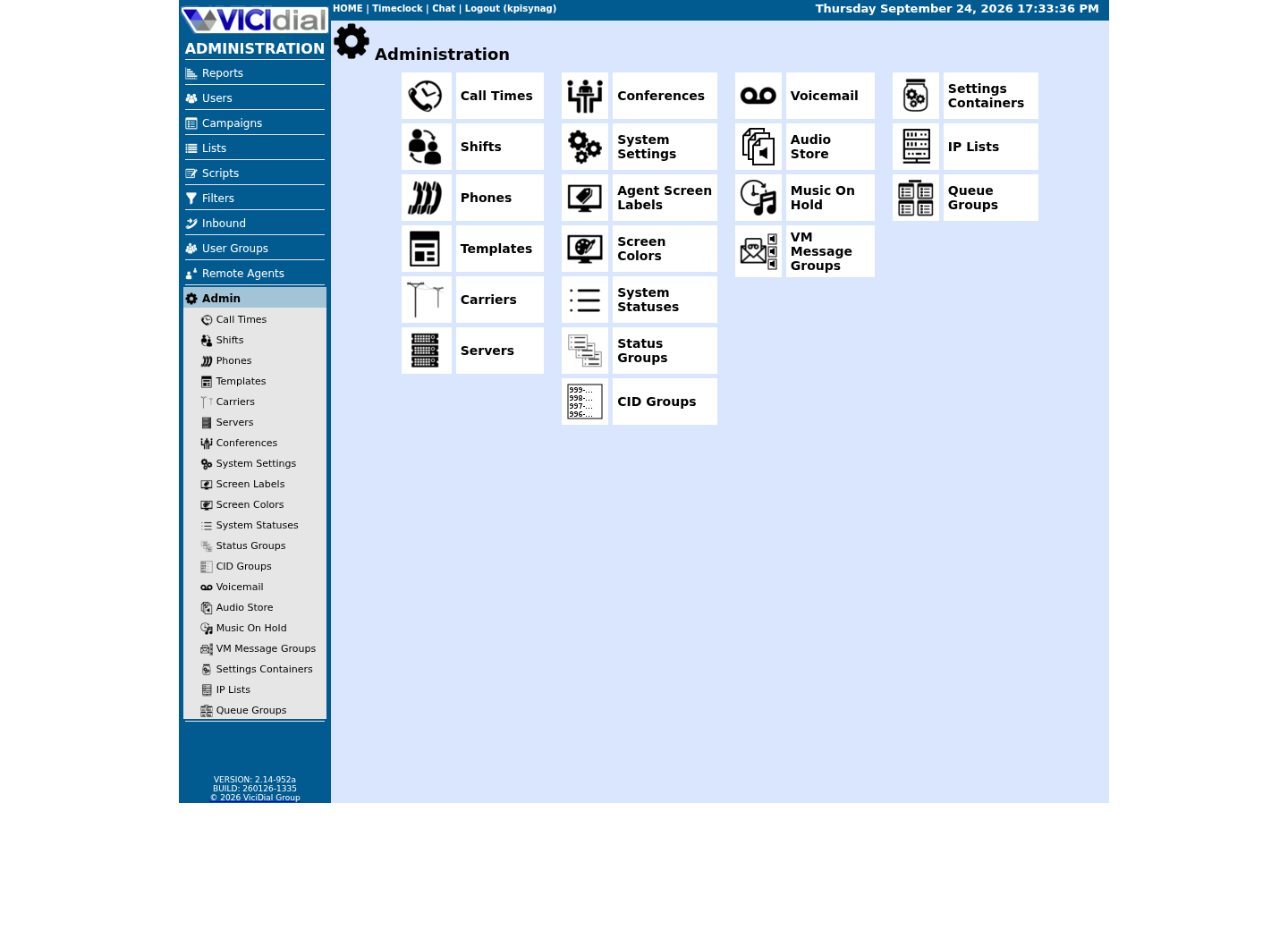
Confirm version and system-wide context
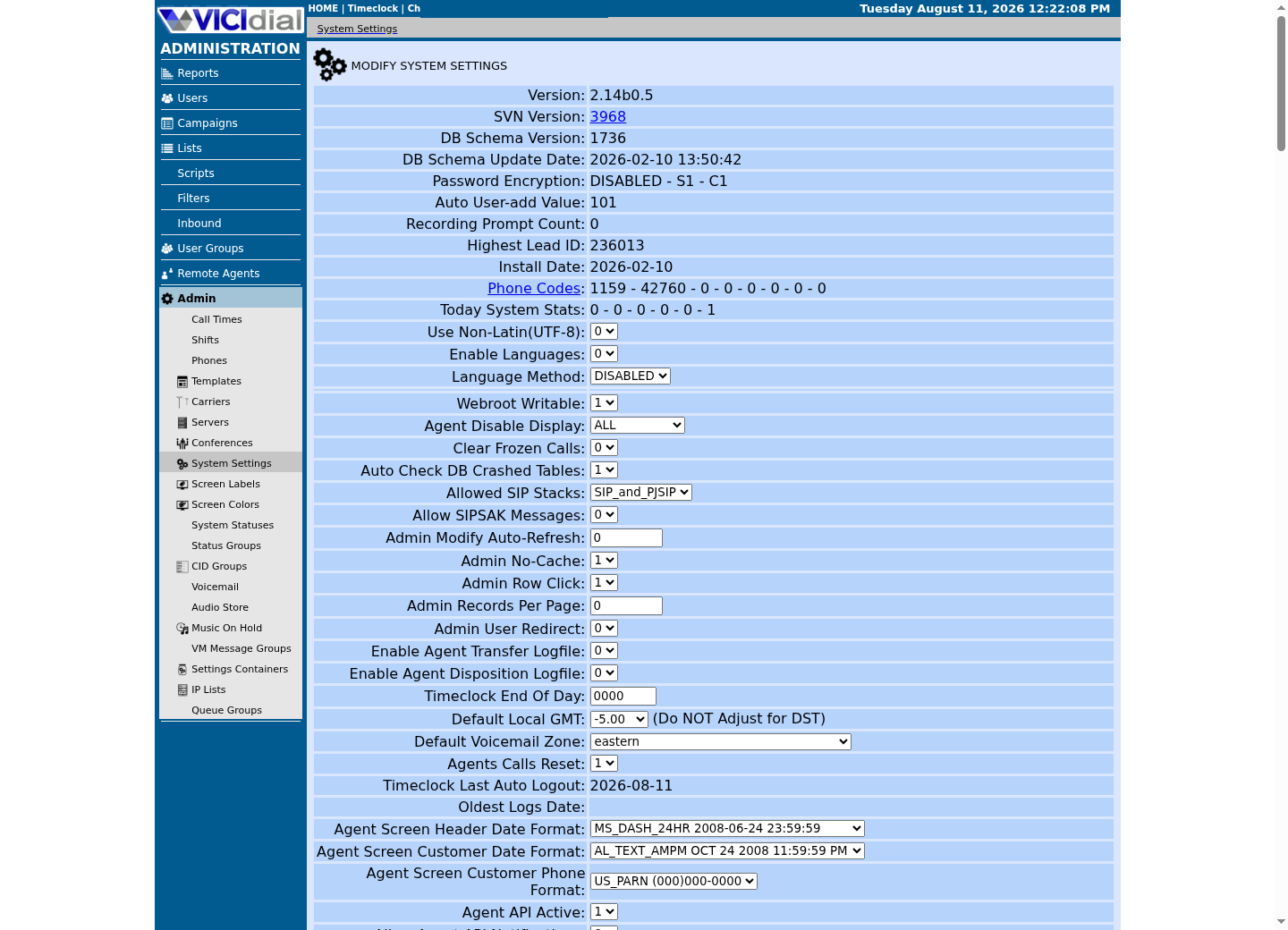
The three questions that decide which page to read
The first question is seat count against a minimum. Five9's own pricing page states a floor of 50 seats before its published Digital ($119 monthly per seat, USD) and Core ($159) plans apply at all, as published 5 August 2026; below that count, those plans are not for sale, full stop. Talkdesk's own pricing page, also as published 5 August 2026, sits at the opposite end: Talkdesk Express is a free tier for businesses under 50 employees, 25 licenses plus a $100 credit, no contract required, available only in the United States and Canada. The same seat-based shape produces a hard floor at one vendor and a free entry point at another; know which side of 50 you are on before either page means anything.
The second question is headcount against peak concurrency. Genesys Cloud CX publishes four tiers billed annually per user per month, CX 1 at $75 up to CX 4 at $240 (USD) as published 5 August 2026, and it sells three different licensing models: named, concurrent, and Hourly Interacting, which is usage-based and charged for interaction time. Its own pricing page states named and concurrent models may not be mixed. An operation with 200 employees taking shifts against 60 simultaneous seats prices very differently under a named model than a concurrent one, and the gap between your headcount and your peak concurrent agents is the number that decides which model is cheaper.
The third question is whether you want a seat license at all. Amazon Connect's own pricing page states plainly there are “no seat-based licensing requirements”: voice runs $0.038 per minute plus standard telephony rates, chat $0.010 per message, email $0.080 per message, and SMS or third-party messaging $0.014 per message, all as published 5 August 2026, with no minimum commitment. VICIdial answers the same question for a different reason: there is no seat license because there is no vendor selling seats, only a server and a carrier relationship the operator owns directly.
- peak_concurrent_agents is what a concurrent-license or usage-priced vendor bills against.
- distinct_agents_last_30_days is what a named-seat license bills against, regardless of how many are ever logged in at once.
- A large gap between the two numbers is itself evidence for which licensing model fits your shift pattern.
SELECT (SELECT COUNT(DISTINCT user) FROM vicidial_live_agents WHERE campaign_id = '<CAMPAIGN_ID>' AND status IN ('READY','INCALL','QUEUE','PAUSED')) AS peak_concurrent_agents, (SELECT COUNT(DISTINCT user) FROM vicidial_log WHERE campaign_id = '<CAMPAIGN_ID>' AND call_date >= DATE_SUB(NOW(), INTERVAL 30 DAY)) AS distinct_agents_last_30_days, (SELECT ROUND(SUM(length_in_sec) / 60, 1) FROM vicidial_log WHERE campaign_id = '<CAMPAIGN_ID>' AND call_date >= DATE_SUB(NOW(), INTERVAL 30 DAY) AND length_in_sec > 0) AS connected_minutes_last_30_days;Captured demo response · 2026-09-24 22:25 UTC. The displayed command is the command that ran; a safe subset label means it was filtered, redacted, or fixture-scoped. Replays only after you select Replay transcript.
- Before you run it
- Run this once with a read-only account, for example mysql --defaults-extra-file=/etc/vicidial-readonly.cnf, during your busiest hour so peak_concurrent_agents reflects real load rather than a quiet moment. This lab scopes all three subqueries to one fixture campaign for a safe capture; on your own install, drop the campaign_id filter for a total across every campaign you run.
- Success looks like
- You have your own peak concurrent agents, distinct agents over the last 30 days, and connected minutes in one place, which is what a seat-based or usage-based quote actually prices against.
- Stop if
- If distinct_agents_last_30_days is far above peak_concurrent_agents, that gap is itself the answer to the named-versus-concurrent question; a large gap favors a usage or concurrent model over a named-seat one.
What each vendor publishes, as of August 5, 2026
Five9 publishes Digital at $119 and Core at $159 monthly per seat (USD), with Plus, Pro and Enterprise quote-only, all behind a minimum of 50 seats. “Five9 vs VICIdial: the seat minimum decides first” works through what that floor means below 50 seats and how to price the alternative once you clear it.
Talkdesk publishes Digital Essentials at $85, Voice Essentials at $105, Elite at $165, and Industry Experience Clouds at $225 per user per month, plus the free Talkdesk Express tier described above. Talkdesk does not publish a minimum seat count or contract length on that page. “Talkdesk vs VICIdial: the true cost of self-hosting” works through that gap and what a per-seat price replaces.
Genesys Cloud CX publishes CX 1 through CX 4 from $75 to $240 per user per month billed annually, across named, concurrent and Hourly Interacting licensing. “Genesys Cloud CX vs VICIdial: the license model is the decision” is built entirely around choosing between those three models.
Amazon Connect publishes no seat price at all: $0.038 per voice minute, $0.010 per chat message, $0.080 per email, and $0.014 per SMS or third-party message, with no minimum commitment. “Amazon Connect vs VICIdial: no seat license on either side” compares that usage-priced shape directly against VICIdial's own economics, since both charge for calls rather than chairs.
RingCentral RingCX is the one platform here with no verifiable published price as of August 5, 2026: two official RingCentral pricing URLs returned HTTP 404 on that date, and third-party figures for a Professional tier conflict with each other on whether annual billing costs more or less than monthly, which is not a pattern a correct price list produces. “RingCX vs VICIdial: the price RingCentral won't publish” documents that gap and what to ask for in a quote instead of repeating a number that may be wrong.
- Only Amazon Connect and VICIdial itself avoid a seat license entirely; every other vendor here prices per user.
- RingCX is the only vendor in this set without a number this publication could verify; get a written quote before comparing it to anything.
Usage pricing and telephony ownership are two different questions
Amazon Connect and VICIdial both answer the seat-license question the same way: neither charges per chair. They diverge on a second question that a per-seat comparison hides — who owns the telephony. Amazon Connect still runs on AWS's own carrier infrastructure; VICIdial requires the operator to own the server and the carrier relationship directly, including patching, backups and recovery.
“VICIdial alternatives: an operator test matrix, not a ranking” groups the realistic options into four buckets: other open-source dialers, commercial contact-center suites such as the five compared here, communications-platform builds where you write the agent experience yourself, and staying on VICIdial under managed hosting instead of self-hosting. Use it if none of the five named vendors is the right group for your situation.
If you want to keep VICIdial itself but stop owning the server, “Managed VICIdial hosting vs self-hosting: a decision framework, not a vendor ranking” maps who owns patching, telephony changes, certificates, monitoring and incident response under each model. Telephony ownership is not only about the server: it includes every carrier relationship registered to it, which is worth counting before assuming a self-hosted box carries less ownership burden than it actually does.
- A usage-priced bill and an owned telephony stack are two separate decisions; Amazon Connect answers the first the way VICIdial does, and the second the way a hosted vendor does.
- Counting your own carrier rows is a starting inventory, not a capacity ceiling; “When to outgrow VICIdial: fixable ceilings versus real reasons to leave” covers the media-port capacity question, not this hub.
SHOW CREATE TABLE vicidial_server_carriers; SELECT carrier_id, carrier_name, protocol, activeFROM vicidial_server_carriersWHERE carrier_id = '<CARRIER_ID>';Captured demo response · 2026-09-24 22:25 UTC. The displayed command is the command that ran; a safe subset label means it was filtered, redacted, or fixture-scoped. Replays only after you select Replay transcript.
- Before you run it
- Run this once with a read-only account, for example mysql --defaults-extra-file=/etc/vicidial-readonly.cnf; the schema check confirms your own build's column names before you trust the SELECT below it. This lab scopes the SELECT to one fixture carrier for a safe capture; on your own install, drop the WHERE clause to list every carrier you operate.
- Success looks like
- You can see exactly which carrier record backs each of your telephony connections, its protocol, and whether it is active, which is what "owning the telephony" actually consists of on the VICIdial side of the relationship.
- Stop if
- If carrier_id is not a column your own SHOW CREATE TABLE output lists, your VICIdial revision has renamed or restructured this table; read the schema output before assuming any column name in this article still applies to your build.
Match your situation to a page
The list below turns your own numbers and the facts above into a next step. Read down the left side for the situation closest to yours, then open the page on the right. None of them names a winner, but each argues its specific comparison in far more depth than a hub page should.
- Two rows can both apply; read every page that matches before pricing anything.
- None of the seven pages linked here name a winner; each argues one specific comparison in depth.
situation: fewer than 50 employees total, want a seat-priced tool with a free tierread: “Talkdesk vs VICIdial: the true cost of self-hosting” situation: 50 or more seats and a straightforward per-seat budget to compareread: “Five9 vs VICIdial: the seat minimum decides first” situation: headcount runs well above peak concurrent agents because of shift coverageread: “Genesys Cloud CX vs VICIdial: the license model is the decision” situation: want to pay per connected minute and per message, no seats at allread: “Amazon Connect vs VICIdial: no seat license on either side” situation: already talking to RingCentral, or holding a RingCX quote to checkread: “RingCX vs VICIdial: the price RingCentral won't publish” situation: comparing open-source dialers, commercial suites and API builds side by sideread: “VICIdial alternatives: an operator test matrix, not a ranking” situation: want to keep VICIdial itself but stop owning the serverread: “Managed VICIdial hosting vs self-hosting: a decision framework, not a vendor ranking”This sample is a template or reading aid, not a terminal command. There is no output to show.
- Before you run it
- Match every row that applies; a real operation often fits more than one situation, and reading two dedicated pages costs less than one wrong quote.
- Success looks like
- You open the one or two dedicated comparisons that actually apply to your seat count, shift pattern and telephony preference, instead of reading all seven.
- Stop if
- If no row matches, measure your own numbers from the earlier query first and treat every vendor quote as unverified until you have it in writing.
Ask every vendor the same five things
Whichever page you read next, bring the same list into the sales conversation. A dated, written number beats a features table, and it beats this hub too.
This hub, and the five comparisons and two framework articles it links, end the same way: with a decision rule and your own numbers, not a recommendation. The right platform depends on facts only you have.
- Get a dated, written price for your actual seat count or usage volume; a sales conversation is not a quote.
- Ask which licensing model, named, concurrent, usage-based or seat-based, the quote assumes, and whether models can be mixed.
- Ask what happens to your data, recordings and configuration if you leave, and how long export actually takes.
- Compare the written quote against your own peak_concurrent_agents, distinct_agents_last_30_days and connected_minutes_last_30_days, not against an industry average.
Evidence ledger
Verification basis
- Every per-seat and per-minute price attributed to Five9, Talkdesk, Genesys Cloud CX or Amazon Connect is quoted verbatim from that vendor's own pricing page, accessed August 5, 2026, not from a reseller or aggregator.
- RingCentral RingCX publishes no verifiable price as of August 5, 2026: two official RingCentral pricing URLs returned HTTP 404 on that date, and third-party figures for it conflict with each other.
- Talkdesk's own pricing page does not publish a minimum seat count or a contract length; a third-party claim of a mandatory 36-month term is not repeated here because Talkdesk's own site does not state one.
- No feature-parity claim is made for any of the five vendors beyond what their own cited pages state.
- No total-cost-of-ownership figure is stated for a VICIdial deployment; it depends on hosting, carrier rates and staffing that vary by operator.
- No vendor is declared better than another anywhere in this hub or in the five dedicated comparisons it links; each ends in a decision rule or a routing choice, not a verdict.
Primary references
Sources
- Five9 pricingFive9 · accessed August 5, 2026
- Talkdesk pricingTalkdesk · accessed August 5, 2026
- Genesys Cloud CX pricingGenesys · accessed August 5, 2026
- Amazon Connect pricingAmazon Web Services · accessed August 5, 2026
- RingCX pricingRingCentral · accessed August 5, 2026
- RingCX contact center overviewRingCentral · accessed August 5, 2026
- VICIdial product overviewVICIdial · accessed August 5, 2026