Reader setup
Before you choose
List your constraints, required evidence and stop rules before you score options.
- Read-only database access to your own VICIdial install, so you can total connected minutes per month instead of estimating them — see vicidial-read-only-database-account if you do not have one yet.
- Your own current carrier per-minute rate and hosting bill, so the arithmetic in this piece maps onto your install instead of a placeholder.
- Access to the AWS pricing calculator, if you want a number to set against your own instead of stopping at the $0.038 headline rate.
- What you will prove
- You will be able to total your own connected minutes per month, run that figure through Amazon Connect's published per-minute rate and through your own carrier and server costs, and set the two resulting numbers side by side.
- Safety boundary
- This is a pricing comparison, not a migration plan or a recommendation; neither model's total is computed here, because hosting, carrier rates and staffing vary too much across operators for one figure to travel from this article to your deployment.
Reader path
How to use this article
- Use it when: You are comparing options and need decision evidence before approval.
- Expected result: Turn options into explicit acceptance criteria and documented stop conditions.
- Start here: Score what is mandatory, keep unknowns visible, then decide only when risks are understood.
The only vendor here with no seat line at all
Fast answer: Amazon Connect, Amazon Web Services' (AWS) cloud contact center as a service (CCaaS) platform, publishes no per-agent seat price at all. Voice is billed at $0.038 per voice minute plus standard telephony rates, chat at $0.010 per message, email at $0.080 per email, and SMS or third-party messaging at $0.014 per message, all as published on aws.amazon.com/connect/pricing on August 5, 2026. That is the same shape VICIdial's own economics already use: pay for calls, not for chairs. So this comparison is not the usual cloud-versus-self-hosted argument built around a monthly seat fee; it is a comparison between two usage-priced models, where the real difference is who operates the platform and where the per-minute money actually goes.
In plain language: an agent is the person logged into the calling screen taking a live call; a campaign is one calling project, meaning the list of leads, the dial method and the agents assigned to work it together; a carrier is the phone company that actually carries the call onto the public telephone network; a trunk is the connection between a server, or a platform like Amazon Connect, and that carrier; and a disposition is the outcome code, such as SALE or NOT INTERESTED, an agent saves once the call ends. Every figure in this article is priced against connected minutes, meaning time an agent and a customer were actually talking, not time spent ringing or on hold.
This is a decision framework, not a ranking: it states Amazon Connect's own published per-unit rates, sets them next to the per-seat quotes this publication has already verified for other vendors, and hands over the query and the formula for turning your own call history into a comparable number. It stops there. It does not compute a total cost for either platform and it does not declare one cheaper, because hosting, carrier rates and staffing differ too much across operators for a single figure to travel from one deployment to the next.
- Amazon Connect's published voice rate: $0.038 per voice minute plus standard telephony rates, as published August 5, 2026.
- Five9, Talkdesk and Genesys Cloud CX each price per seat per month; VICIdial and Amazon Connect do not.
- This piece supplies a formula and a query, not a total cost of ownership or a verdict.
Visual walkthrough
Follow three real demo screens
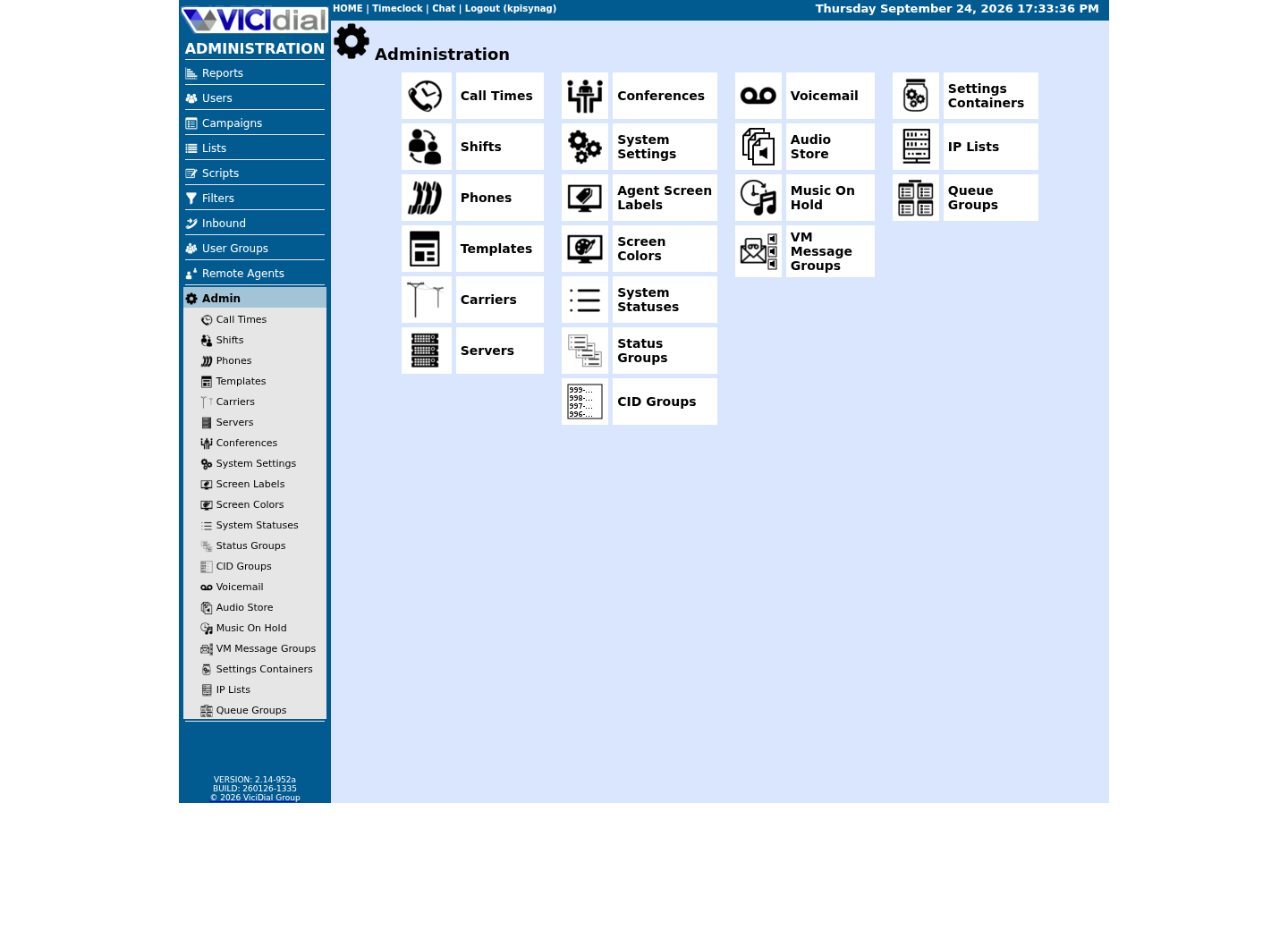
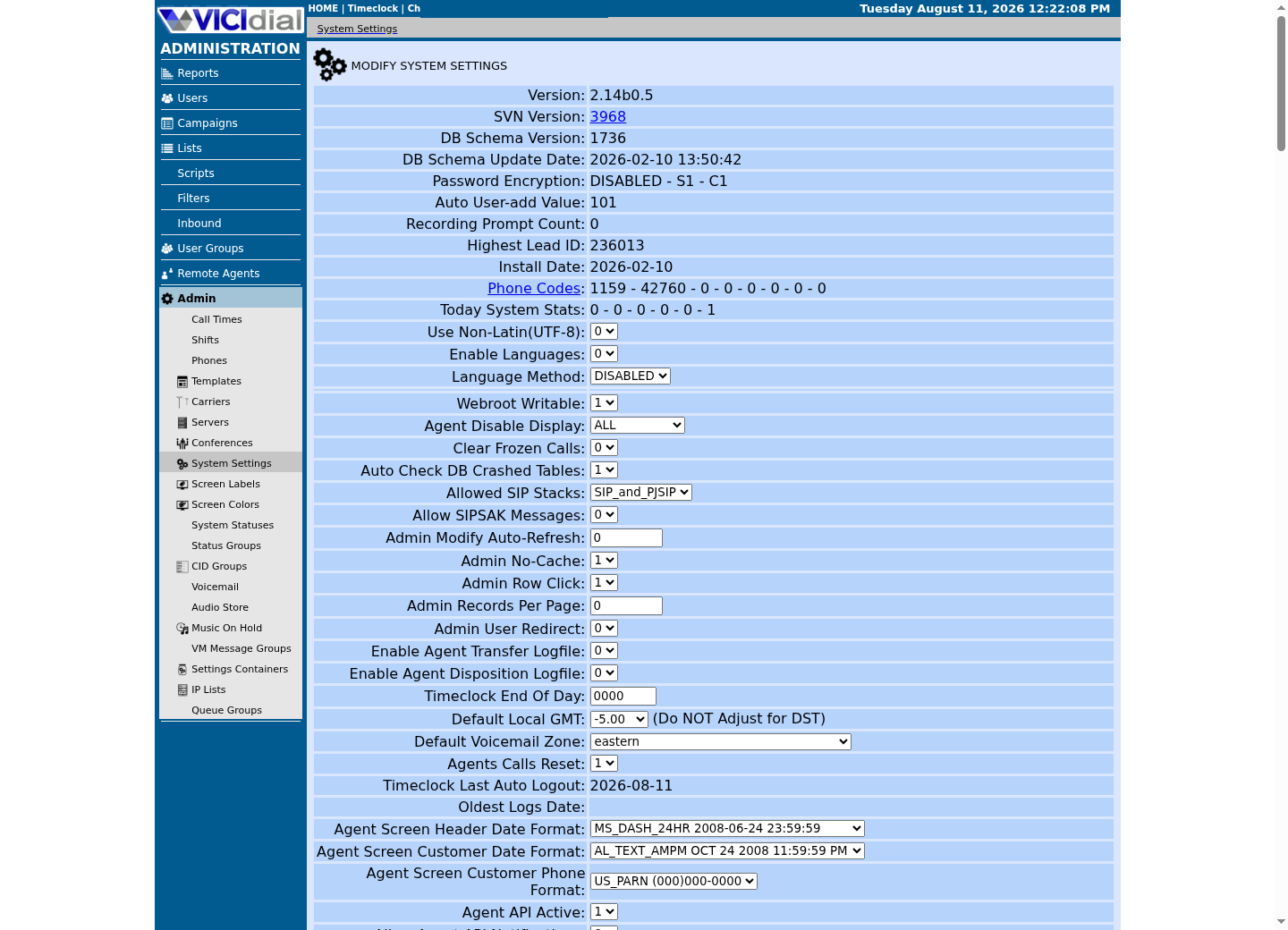
Captured on an isolated VICIdial demo: Administration screens on September 24, 2026, and the idle Agent screen on August 11, 2026. Each caption states its own capture time, and every sanitized image helps you recognize a related screen; none proves that this article's call, command, or result occurred.Start at Administration home
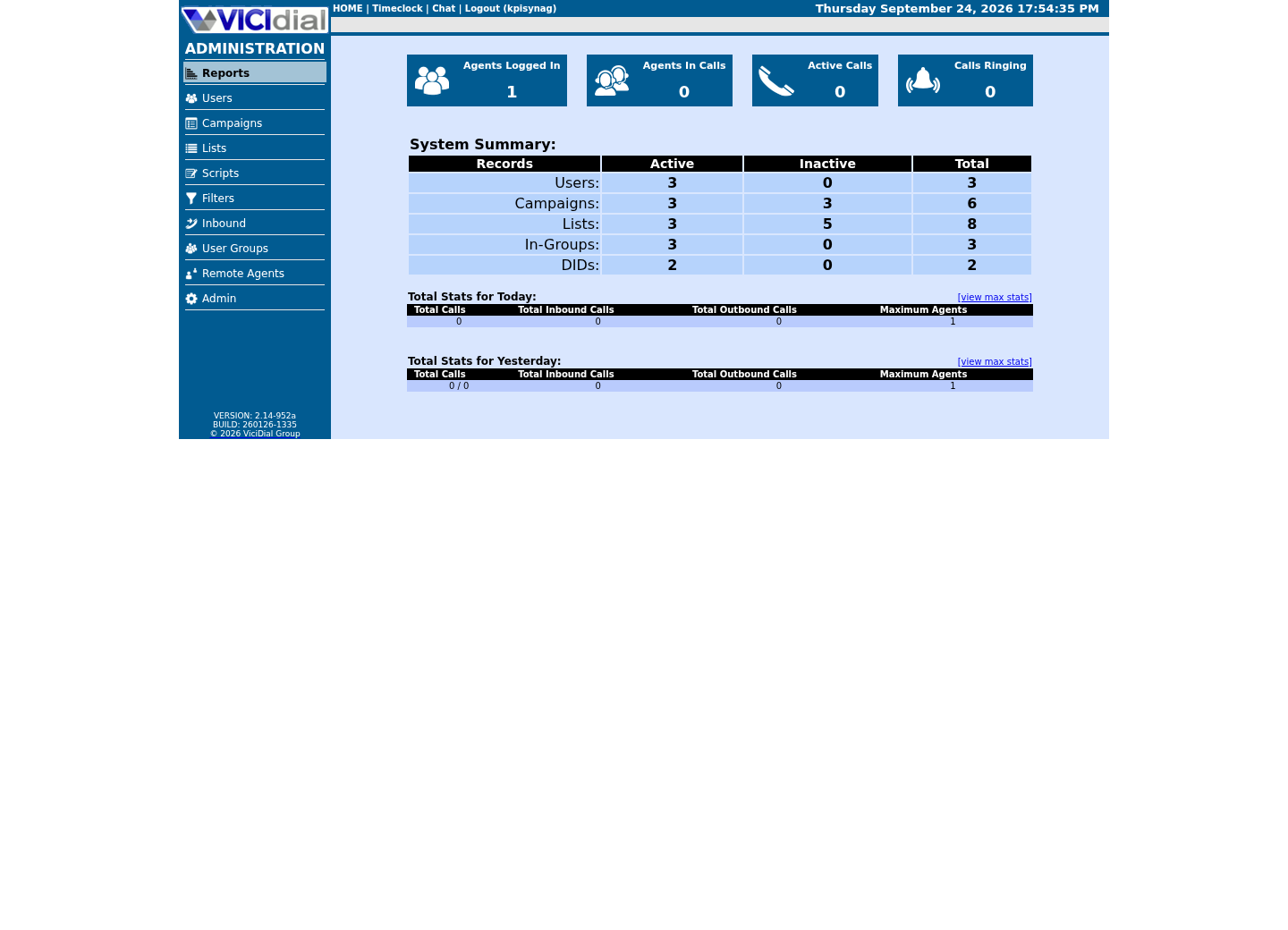
Use the Administration menu as a map
Confirm version and system-wide context
Two pricing shapes, read straight off each vendor's own page
Amazon Connect's own pricing page, accessed August 5, 2026, states plainly that there are 'no seat-based licensing requirements,' and adds 'no minimums, no long-term contracts, pay for what you need.' Four line items carry that claim: voice at $0.038 per voice minute, with standard telephony rates applying on top; chat at $0.010 per message sent or received; email at $0.080 per email sent or received; and SMS or third-party messaging at $0.014 per message. There is no fifth line for a seat, because Amazon Connect does not sell one.
Three other vendors already verified on this site publish the opposite shape. Five9 lists Digital at $119 and Core at $159, both per seat per month, with Plus, Pro and Enterprise sold only as a custom quote, and a minimum of 50 seats attached to every published tier - likely the single most decision-relevant fact on that page. Talkdesk lists Digital Essentials at $85, Voice Essentials at $105, Elite at $165 and Industry Experience Clouds at $225, all per user per month, and its own page does not publish a minimum seat count or contract length, so none is asserted here. Genesys Cloud CX lists CX 1 at $75, CX 2 at $115, CX 3 at $155 and CX 4 at $240, all per user per month billed annually, under named, concurrent or Hourly Interacting license models - Genesys's own page states named and concurrent models may not be mixed. Every figure in this paragraph is dated August 5, 2026, read from each vendor's own pricing page.
Those four Amazon Connect rates are the entire headline, not the entire bill. Telephony rates, phone number leasing and a long list of per-feature charges sit underneath them on AWS's own pricing page, and they vary by country, number type and which optional features a deployment turns on. Price a real workload on the AWS pricing calculator before treating $0.038 as a monthly cost, and treat every number in this section as a rate, not a ranking: nothing fetched for this article supports a reliability or feature-parity claim across any of these vendors.
Same shape, different owner: who operates the platform underneath the rate
Amazon Connect's $0.038 per voice minute is not just a carrier pass-through; it is AWS's charge for operating the entire platform sitting behind that minute. Call routing, queueing, an interactive voice response (IVR) tree if the campaign uses one, the agent workspace and recording all run on infrastructure AWS builds, patches and scales, and the per-minute rate is how that operating cost reaches the bill. Standard telephony rates are billed alongside it as a separate component, because carrying the call onto the phone network is a distinct charge from running the contact center software above it.
VICIdial has no equivalent per-minute platform fee to any vendor, because there is no vendor operating a shared platform underneath it. Every dollar that leaves the operator's account for a connected minute goes to a carrier for carrying that call and, indirectly, to whatever it costs to run and maintain the server doing the routing, recording and dialing. Nobody else is billing a margin on top of that minute, but nobody else is patching, scaling or monitoring the media path either - the operator owns capacity planning that Amazon Connect's usage price already has baked in. That capacity ceiling is covered in full in “Elastic SIP trunking for predictive dialers: why your own media path is the real ceiling”: a predictive campaign's dial level, not agent headcount, decides how many concurrent audio streams the server has to carry, and that ceiling is a per-install setting in Asterisk's own RTP configuration, not a fixed number -- read rtpstart and rtpend in /etc/asterisk/rtp.conf on your own server before assuming what it is.
The carrier line itself is also something a VICIdial operator can act on directly, in a way an Amazon Connect account mostly cannot. That specific lever is covered in “VICIdial least-cost routing: cut carrier costs with dial prefixes, not a rate engine”, which walks through routing a specific destination range to a cheaper carrier using a campaign's dial prefix and a carrier's own dialplan entry, then measuring the real answer-seizure ratio and connected minutes that route produces. Amazon Connect's telephony rate is set by AWS's own published rate card for the destination being dialed; there is no equivalent dial-prefix lever inside Amazon Connect's model, because AWS is the one operating that layer.
- Amazon Connect's per-minute rate bundles platform operation and telephony into one bill AWS controls end to end.
- VICIdial's per-minute cost is just the carrier bill; the operator supplies and maintains the server capacity that carries it.
- Only a VICIdial operator can re-route a specific destination to a cheaper carrier at the dial-prefix level; Amazon Connect's telephony rate is not something the account holder negotiates by route.
The one number this whole comparison needs: connected minutes per month
Every number in the arithmetic ahead depends on one figure: how many minutes of actual conversation the operation runs in a month. Amazon Connect bills against it directly. A VICIdial operator's own carrier invoice is priced against it too, whether or not anyone has ever pulled it out of the call log and looked at it as a single monthly total.
VICIdial already stores that number. vicidial_log.length_in_sec records the actual talk time of each logged call, in seconds, the same field this publication's own least-cost routing guide uses to compute connected minutes per carrier. Summed by month instead of by carrier, it is the input the rest of this page has been building toward.
SELECT DATE_FORMAT(call_date, '%Y-%m') AS call_month, SUM(length_in_sec) AS connected_seconds, ROUND(SUM(length_in_sec) / 60, 2) AS connected_minutesFROM vicidial_logWHERE campaign_id = '<CAMPAIGN_ID>' AND call_date >= CURDATE() - INTERVAL 12 MONTHGROUP BY call_monthORDER BY call_month;Captured demo response · 2026-09-24 22:25 UTC. The displayed command is the command that ran; a safe subset label means it was filtered, redacted, or fixture-scoped. Replays only after you select Replay transcript.
- Before you run it
- Run this with a read-only account, mysql --defaults-extra-file=/etc/vicidial-readonly.cnf, widening or narrowing the 12-month window to whatever period your own carrier invoice covers. This lab scopes the query to one fixture campaign for a safe capture; on your own install, point it at your own real campaign, or drop the filter for an org-wide total.
- Success looks like
- On our ViciBox 12 lab the fixture campaign has no calls logged across the last 12 months, so this comes back as zero rows rather than one row per month; on a real campaign with call history, expect one row per month, each with a connected_minutes figure you can set directly against that month's carrier invoice or against the Amazon Connect arithmetic in the next section.
- Stop if
- Zero rows across all 12 months means no logged calls yet for that campaign, not a populated-but-wrong number -- confirm the campaign filter actually points at an ID with call history before troubleshooting further. Once rows do return, if connected_minutes looks implausibly low or high for a month you remember clearly, check whether length_in_sec is populated for every call type your dial methods produce before trusting the total, rather than assuming the query is wrong.
The formula: what to do with that number on each side
Amazon Connect's side of the arithmetic is short, because the published rate is a flat per-minute number: multiply connected minutes per month by $0.038 for the voice platform charge, then add the standard telephony rate for the destinations actually being dialed, which AWS prices separately by country and number type. Add a line each for chat, email or SMS only if the workload actually uses them, at $0.010, $0.080 and $0.014 per message respectively, as published August 5, 2026.
VICIdial's side of the same arithmetic has no platform-fee line to multiply, only two operator-owned bills to add: the carrier's own per-minute rate for the connected minutes above, and whatever the server currently costs to run. Sizing that second figure from a real workload instead of a lab result is covered in “VICIdial VPS requirements and cost: separate a lab floor from production capacity”, and the further choice of who operates that server, which changes the second bill's size without changing the first, is covered in “Managed VICIdial hosting vs self-hosting: a decision framework, not a vendor ranking”.
Neither total is computed here. Run both sides with your own connected-minutes figure, your own carrier's quoted rate and your own current or quoted hosting bill, and the two numbers that come out are the ones worth comparing, not any figure printed in this article.
connected_minutes_per_month = [from the query above] Amazon Connect estimate voice_line = connected_minutes_per_month x $0.038 telephony_line = connected_minutes_per_month x [your AWS telephony rate per minute, by destination] other_lines = [chat messages x $0.010] + [emails x $0.080] + [SMS messages x $0.014], only if used amazon_connect_monthly_estimate = voice_line + telephony_line + other_lines VICIdial estimate carrier_line = connected_minutes_per_month x [your carrier's quoted per-minute rate] server_line = [your current or quoted monthly hosting bill] vicidial_monthly_estimate = carrier_line + server_line This sample is a template or reading aid, not a terminal command. There is no output to show.
- Before you run it
- Fill in every bracketed placeholder from your own connected-minutes query, your own carrier's rate sheet and your own hosting quote before comparing the two totals; none of the bracketed values are asserted anywhere in this article.
- Success looks like
- Both estimates use the same connected_minutes_per_month figure, and every other input came from a quote or invoice you hold, not from a number printed in this piece.
- Stop if
- A bracketed value got filled in from a guess, an old quote, or a rate this article stated for a different vendor: stop and get the current number in writing before treating either total as real.
Where to go next if the decision is bigger than one rate card
This page compares two usage-priced models on their published rate and their per-minute arithmetic. If the real decision in front of you is whether to stay on VICIdial at all, that workflow-level comparison is covered in “VICIdial alternatives: an operator test matrix, not a ranking”, which sets out the tests worth running against any candidate, Amazon Connect included, before a demo turns into a migration.
If the decision is instead about capacity rather than platform, and the connected-minutes total from the query above is already climbing past what one server comfortably carries, that split is covered in “Scaling VICIdial: designing a multi-server cluster for 500+ agents”, which sets out what has to move across more than one box, and at what point that becomes the more relevant comparison than any per-minute rate.
None of the figures on this page substitute for a quote. Price Amazon Connect on AWS's own calculator for the actual mix of voice, chat, email and SMS a workload uses, and get a current rate sheet from your own carrier before either total from the previous section is treated as more than an estimate.
- Comparing VICIdial against more than one alternative: use “VICIdial alternatives: an operator test matrix, not a ranking”.
- Comparing capacity rather than price: use “Scaling VICIdial: designing a multi-server cluster for 500+ agents”.
- Either way, reprice on the vendor's own calculator or rate sheet before trusting a headline number.
Evidence ledger
Verification basis
- Amazon Connect's per-minute and per-message rates, and its 'no seat-based licensing requirements' statement, are quoted verbatim from Amazon Web Services' own pricing page, accessed August 5, 2026, not from a reseller or aggregator site.
- Five9's, Talkdesk's and Genesys Cloud CX's per-seat prices and tier names are quoted verbatim from each vendor's own pricing page, accessed the same day, for contrast only.
- No feature-parity claim is made for any vendor beyond what its own cited page states, and no reliability or support ranking is made for any vendor.
- No total-cost-of-ownership figure is stated for a VICIdial deployment; it depends on hosting, carrier rates and staffing that vary by operator.
Primary references
Sources
- Amazon Connect pricingAmazon Web Services · accessed August 5, 2026
- Five9 pricingFive9 · accessed August 5, 2026
- Talkdesk pricingTalkdesk · accessed August 5, 2026
- Genesys Cloud CX pricingGenesys · accessed August 5, 2026