Reader setup
Before you choose
List your constraints, required evidence and stop rules before you score options.
- Workload outline
- Recovery objectives
- Whoever will own the decision, even if that is only you
- What you will prove
- A traceable hosting-model comparison.
- Safety boundary
- Do not treat it as a vendor ranking, legal opinion, or price quote.
Reader path
How to use this article
- Use it when: You are comparing options and need decision evidence before approval.
- Expected result: Turn options into explicit acceptance criteria and documented stop conditions.
- Start here: Score what is mandatory, keep unknowns visible, then decide only when risks are understood.
Choose the operating model that can prove your controls
Fast answer: choose managed hosting when its contract and evidence cover the operational controls you cannot staff, and self-host when you can reliably own patching, telephony, observability, recovery and security. Neither label proves quality by itself.
This is a decision framework, not a review or ranking. It assumes you have defined jurisdictions, call volumes, integrations, recording policy and recovery objectives; CRM means customer relationship management. It does not evaluate named providers or promise compliance.
This comparison assumes familiarity with VICIdial's own vocabulary, including Asterisk and carrier; the companion article “VICIdial terminology for complete beginners: users, phones, campaigns and leads” defines them for a first-time reader.
- Prerequisites: a workload outline, recovery targets and a named business owner for each control.
- Non-goal: this is not legal advice, a vendor ranking or a certification.
- Require evidence dated to the proposed service.
Visual walkthrough
Follow three real demo screens
Captured on an isolated VICIdial demo: Administration screens on September 24, 2026, and the idle Agent screen on August 11, 2026. Each caption states its own capture time, and every sanitized image helps you recognize a related screen; none proves that this article's call, command, or result occurred.Start at Administration home
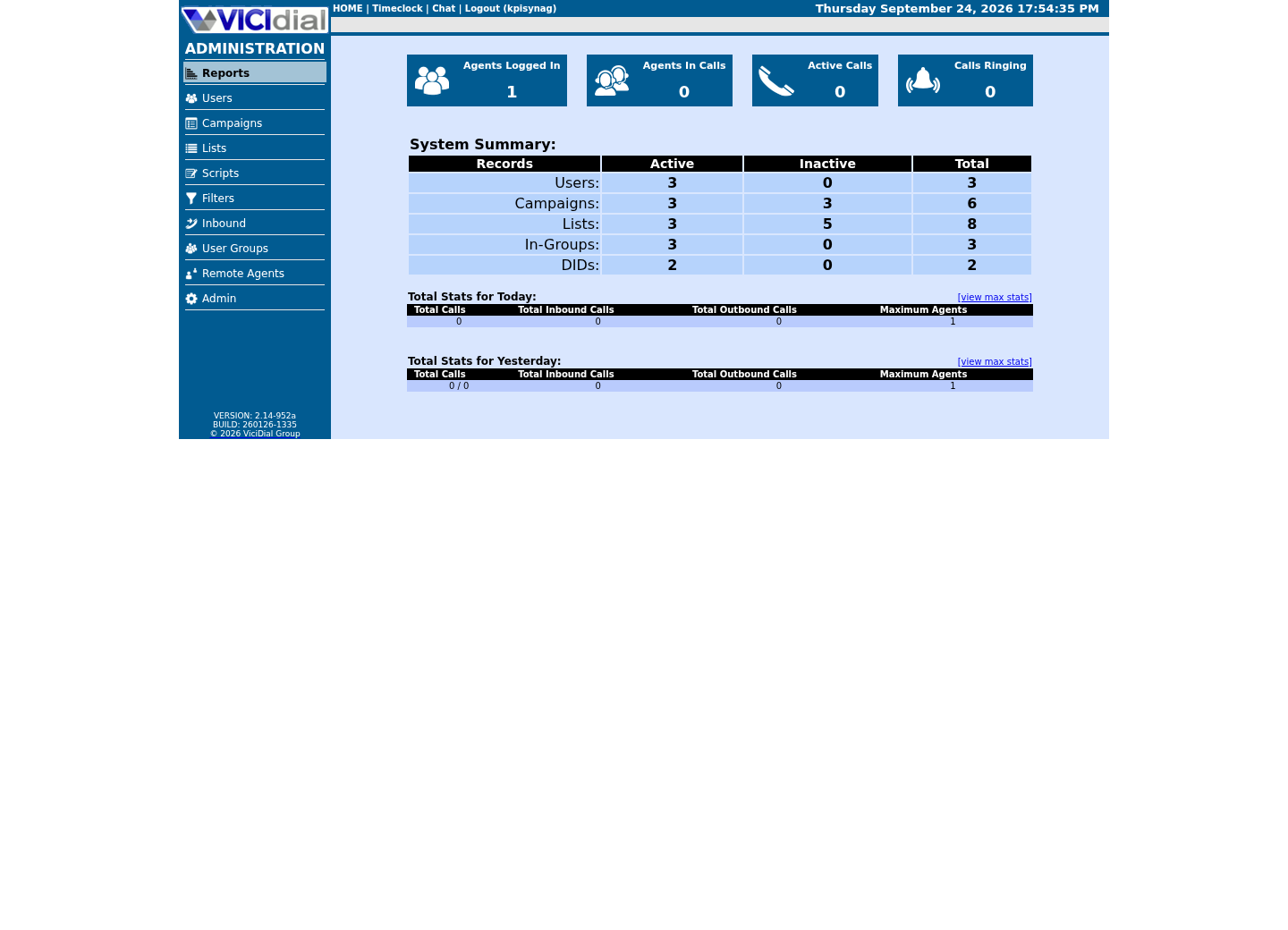
Use the Administration menu as a map
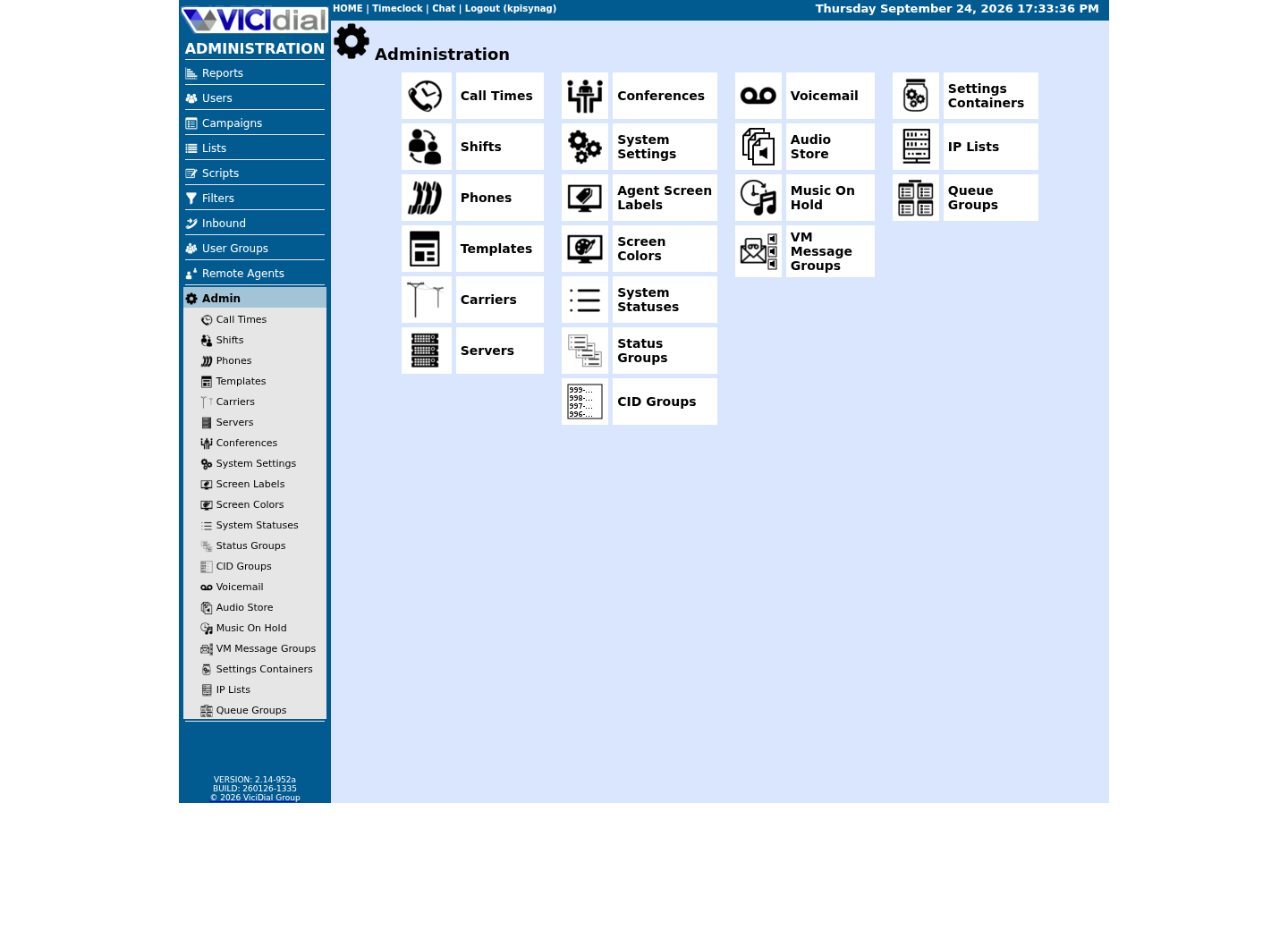
Confirm version and system-wide context
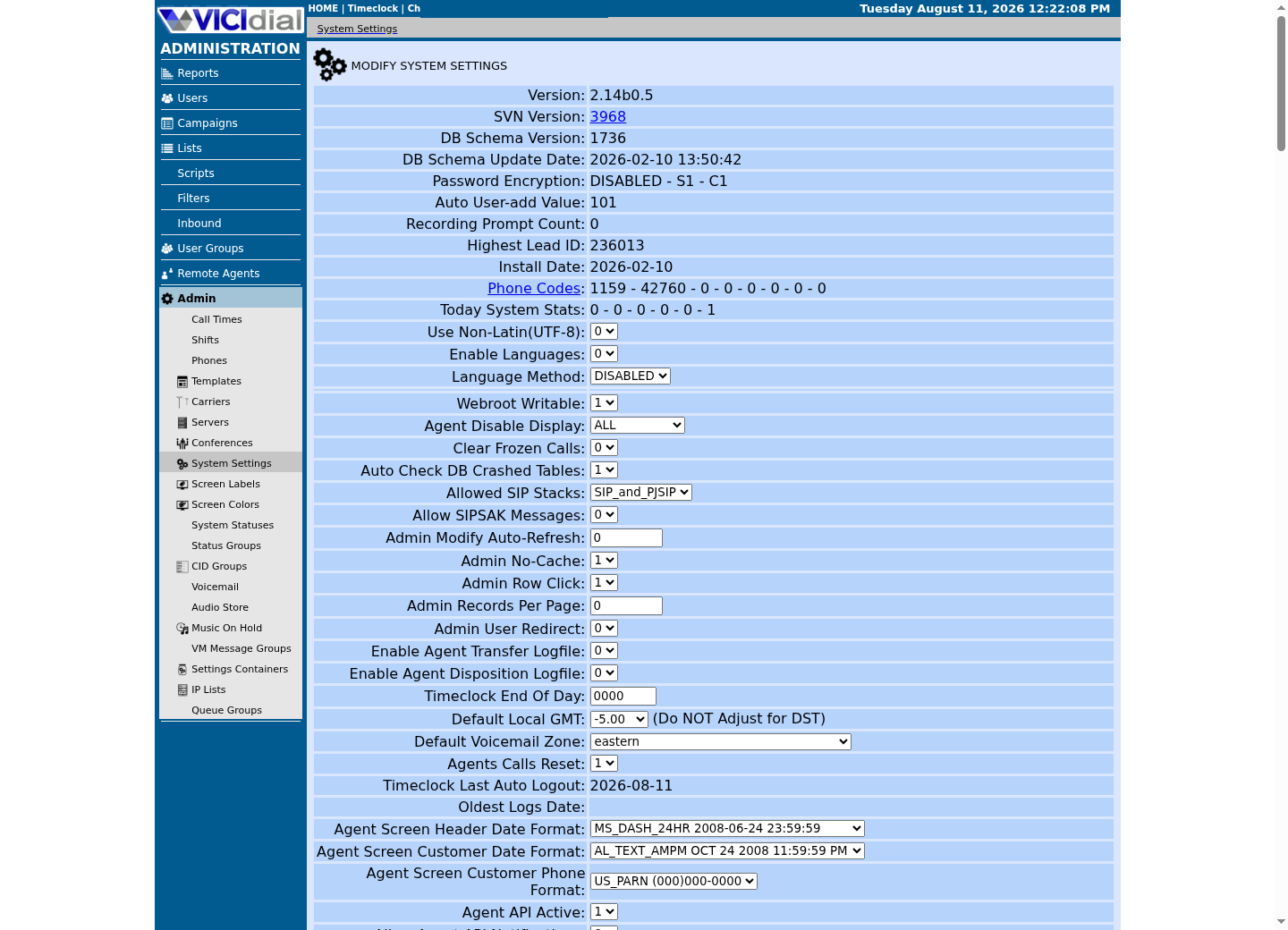
Map shared responsibility down to the call path
Ask who owns OS patching, VICIdial/Asterisk changes, certificates, PJSIP/provider configuration, firewall rules, database care, recordings, access review, monitoring and incident response. “Fully managed” is incomplete until each item has an owner and escalation time.
For self-hosting, name people and coverage windows rather than an organization label. For managed service, ask whether you retain exports, configuration backup, audit access and a safe exit path. Complete this worksheet from contract language; an unassigned row is a stop condition.
- Request the change-management and emergency-change process.
- Confirm least-privilege administrative access.
- Document data processors and support access boundaries.
control = certificate renewalmanaged_owner = [name or role]self_hosted_owner = [name or role]evidence_to_request = [dated test or document]escalation_time = [duration]This sample is a template or reading aid, not a terminal command. There is no output to show.
- Before you run it
- Replace bracketed placeholders with roles, never personal contact data, in a private evaluation record.
- Success looks like
- Each control has one accountable owner and dated evidence.
- Stop if
- Stop selection when a required control has no owner or evidence.
Ask for testable evidence, not assurances
A credible candidate can describe backup scope, restore testing, RTO/RPO measurement, monitoring, patch cadence, vulnerability response, logging/redaction, region and subprocessor boundaries. Ask what was tested, when, under which assumptions, and what was not tested.
Distinguish source-present, configured, enabled and functionally-verified evidence. For example, a backup policy is source evidence; an encrypted job configured is not a successful restore; a recent scoped restore drill is functional evidence.
- Request redacted operating-procedure and drill summaries.
- Verify SLA exclusions and maintenance windows.
- Avoid sending credentials or customer data during evaluation.
Compare total operating cost and risk
Compare more than monthly compute: include engineering coverage, on-call burden, audits, backups, egress, monitoring, carrier management, downtime exposure and migration effort. A low advertised fee can omit the control you most need.
Use the same workload and retention assumptions for each option. Treat quotes as dated inputs and include a contingency for growth, security remediation and a provider exit. This worksheet is a comparison template, not a price claim; leave a cost blank until a dated quote supplies it.
- Create a one-year and two-year scenario.
- Price recordings and restores explicitly.
- Record every assumption next to the quote.
option = [managed or self-hosted]compute_and_storage = [dated quote]on_call_coverage = [included or separate]restore_drill_evidence = [date or missing]exit_assistance = [contract term]open_risks = [list]This sample is a template or reading aid, not a terminal command. There is no output to show.
- Before you run it
- Fill bracketed placeholders from current written terms and approved internal estimates.
- Success looks like
- Both options use the same assumptions and missing evidence is visible.
- Stop if
- Stop comparison if terms, recovery evidence or exit details are absent.
Make reversibility a selection criterion
Before signing, prove that you can export configuration and data in a usable format, obtain recordings under your authorization model, revoke access, and restore elsewhere. Run a bounded migration rehearsal using synthetic data if possible.
Stop if a candidate cannot identify backup ownership, recovery testing, administrator access controls, data location, breach notification path or termination procedure. The independent verification is a contractual review plus a scoped exercise, not a sales presentation.
- Set acceptance criteria in the agreement.
- Keep an offline contact/escalation roster.
- Review the model after the first incident or restore drill.
Evidence ledger
Verification basis
- No hosting vendor was tested, endorsed or ranked.
- No single lab build establishes HA, production capacity, backup/restore or provider interoperability evidence for any hosting model.
- This framework requires each candidate to provide its own dated, contractual evidence.
Primary references
Sources
- NIST Cybersecurity Framework 2.0NIST · accessed August 4, 2026
- CISA Secure by DesignCISA · accessed August 4, 2026
- VICIdial product overviewVICIdial · accessed August 4, 2026